
Who is this for?
👤 Admins
👁️🗨️ Available for all plans
In this article
Putting it together: an example
➡️ Manage Roles
How access works in Showell
Everyone in your Workspace has their own user account. What each person can do and see comes from four building blocks:
- Role: what someone can do. Every user has exactly one role: Admin, Member or a custom role.
- Groups: who belongs together. You use groups to give content privileges, send notifications and compare analytics.
- Organization: which company someone is part of, such as a dealer or partner. An organization has (optionally) its own brand and, together with a custom role, keeps people within their own organization.
- Privileges: which content someone can open or edit. You set them per folder or file, for groups, organizations or single users.
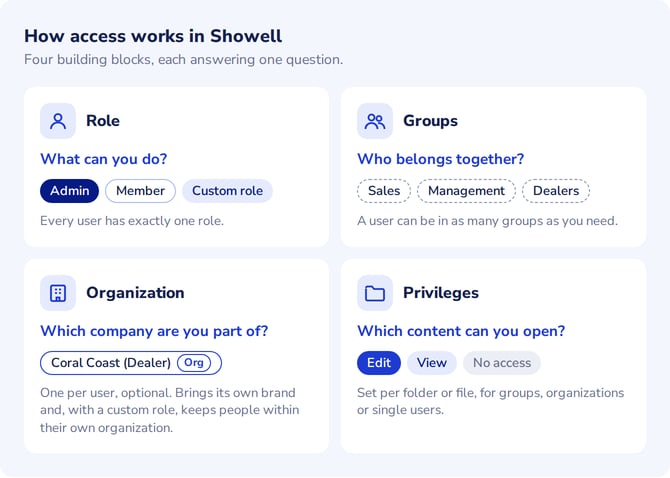
Roles and privileges always work together: the role decides what a person can do, and privileges decide on which content. On top of that, every file, folder, presentation and Share has an owner.
Roles
Admin
Admins have full control of the Workspace. They can:
- View, edit, upload and remove all content
- View, edit and remove Shares from any user
- Manage users, roles, groups, organizations and content privileges
- See all analytics and send notifications
- Brand the Workspace and manage integrations and add-ons
Admins keep this workspace-wide access, even when they belong to an organization. Typically, marketing and sales leadership, or whoever runs the Workspace, are Admins.
Member
Member is the default role for new users. Members can:
- Find, view, present and share the content they have access to
- Upload their own materials to My Files and create Presentations
- Create Shares, invite collaborators, and work on Shares where they are a collaborator
- Manage content in folders where they have Edit privileges, once file Edit mode is turned on for all users in General preferences
Typically, sales reps, service teams and dealers are Members.
Custom role
A custom role is a reusable set of permissions you build yourself. It starts from Member and gives a user more, or less, without making them a full Admin.
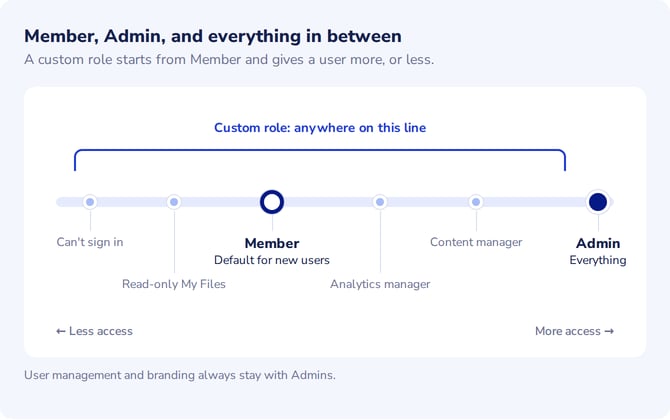
For example:
- An analytics manager who follows all results, without being an Admin
- A content manager who looks after all content and brand assets
- A dealer manager who only sees the people and analytics of their own organization, and can notify them
- A user whose My Files is read-only, or who cannot sign in at all
User management and branding always stay with Admins. You create and assign custom roles in the Showell App for Web, under Admin > Custom Roles, and they apply in every Showell App. For every option and all the steps, see Manage Roles.
Groups and organizations
You manage both in the Showell App for Web, under Admin > Groups & Organizations.
Groups
A group collects users by whatever fits your company: team, product line, country, or internal versus external. Use groups to:
- Give content privileges to many people at once
- Send notifications to everyone in a group
- Compare activity in Group analytics
A user can belong to as many groups as you need.
Organizations
An organization is a special kind of group for a company or unit that should have its own space in your Workspace, such as each dealer, distributor, partner or subsidiary.
- One per user: each user belongs to one organization at most. Your Workspace can have as many organizations as you need.
- Works like a group: you can give an organization content privileges, and send it notifications.
- Brand: give an organization its own brand if you like, and its members see that brand, also in the Digital Sales Rooms they share.
- Invitations: invite people into an organization, and they join it as soon as they accept.
- Boundaries, with a custom role: give members a custom role with organization options, and they stay within their own organization:
- Users: they only see the people in their own organization ("View Org Users")
- Analytics: they see their own organization's analytics, including Share analytics ("Read Org Analytics")
- Notifications: they can notify the people in their own organization ("Notify Org Users")
Without such a role, members of an organization see and are seen like everyone else. Users who are not in any organization keep working as before, see the FAQ below.
For all the steps, see Groups & Organizations: Setup Guide.
Privileges
Privileges decide who can open or manage which content. You set them on every folder, subfolder or file, in Edit mode, under the item's access settings:
- All workspace users: what everyone in the Workspace gets: View, Edit or No access.
- Groups, organizations and users: exceptions on top of that, for example View for the Sales group, View for one dealer's organization, or Edit for the Management group.
Edit privileges let someone add and organize content in the Showell App for Web, once file Edit mode is turned on for all users in General preferences. A custom role can narrow privileges further, for example to read-only, or lift someone above them with a "Manage all" option.
For all the steps, see Set User/Group Privileges to your Contents.
Ownership
Owner is not a role. It tells you who an item belongs to.
- Whoever uploads a file, creates a folder or makes a presentation becomes its owner.
- Whoever creates a Share (Digital Sales Room) owns it. Owners can add collaborators, hand over ownership, and give collaborators access to files from their My Files.
Read more in Share Collaboration and Ownership.
Putting it together: an example
Acme Energy sells through its own sales team and through two independent dealers, Coral Coast and Lowland Volt. Here is how they set up access, step by step.
Step 1: Roles, groups and organizations
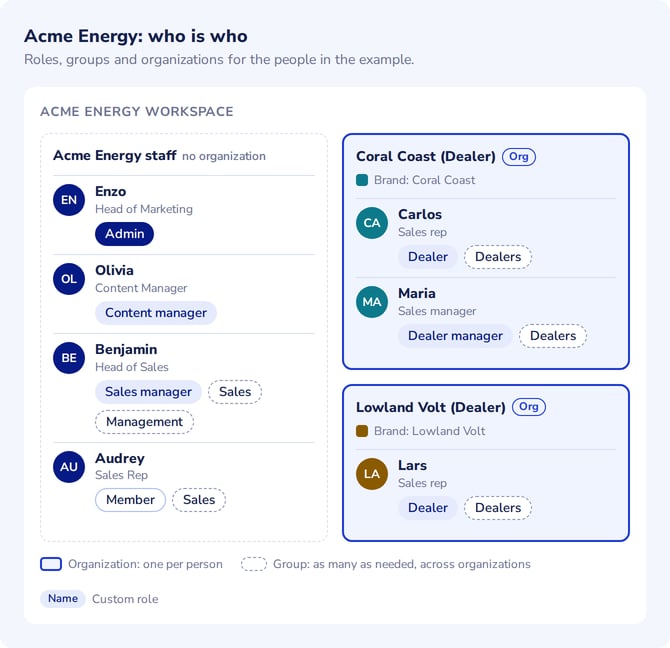
Acme Energy's own team is not in an organization. They see everyone in the Workspace.
- Enzo, Head of Marketing: Admin. He runs the Workspace and invites the right people.
- Olivia, Content Manager: custom role "Content manager", with Manage all Workspace Files and Manage all App Resources. She looks after all content and brand assets, without access to users or Workspace settings.
- Benjamin, Head of Sales: custom role "Sales manager", with Read all Analytics, to follow every result. Groups: Sales, and Management, which may edit the Solutions folder.
- Audrey, Sales Rep: Member, in the Sales group.
The dealers each get their own organization, with their own brand. All dealer users are also in one Dealers group, so content meant for every dealer only needs one privilege.
- Carlos, sales rep at Coral Coast: custom role "Dealer", with View Org Users. He only sees his Coral Coast colleagues, for example when he adds Share collaborators, and his Digital Sales Rooms carry the Coral Coast brand.
- Maria, sales manager at Coral Coast: custom role "Dealer manager", with View Org Users, Read Org Analytics and Notify Org Users. She follows Coral Coast's results and keeps her team informed, without seeing other dealers.
- Lars, sales rep at Lowland Volt: the same "Dealer" role, in the Lowland Volt organization. He and the Coral Coast team never see each other.
Step 2: Privileges on the content
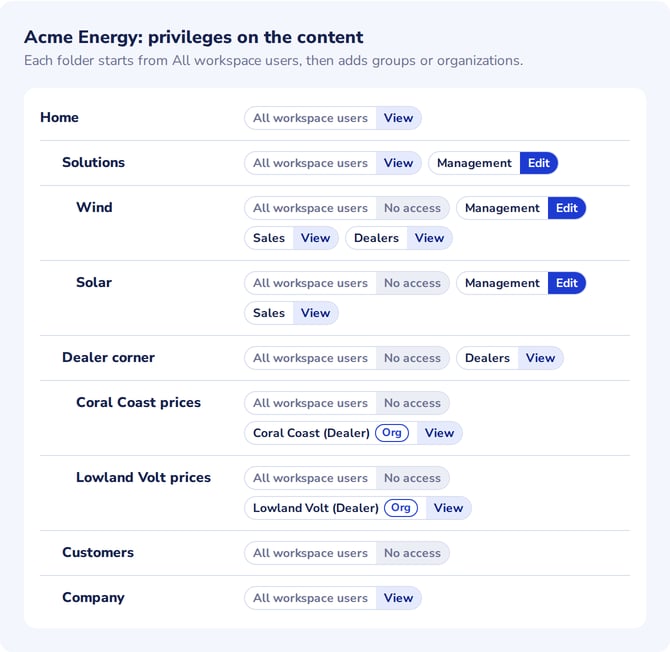
- Home and Company: All workspace users can view.
- Solutions: All workspace users can view. The Management group can edit.
- Solutions > Wind: No access for All workspace users. Management can edit, Sales and Dealers can view.
- Solutions > Solar: No access for All workspace users. Management can edit, Sales can view. Solar is not sold through dealers, so they do not see it.
- Dealer corner: No access for All workspace users, View for the Dealers group.
- Dealer corner > Coral Coast prices and Lowland Volt prices: each one is only open to its own dealer's organization.
- Customers: No access for All workspace users, because it holds sensitive material.
The result
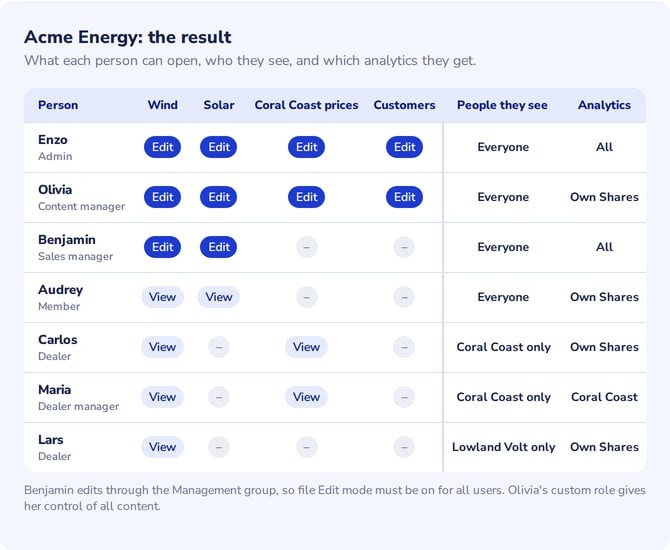
- Audrey and Benjamin see all sales content. Only Benjamin, through the Management group, can edit it.
- Every dealer sees the Wind content and the Dealer corner, and only their own price list.
- Carlos, Maria and Lars only see their own colleagues, and share under their own brand. Maria sees Coral Coast's analytics, and nothing from Lowland Volt.
- Customers stays hidden from everyone except the Admins and Olivia, whose custom role gives her control of all content.
Planning a structure of your own? See Plan your Content Structure.
💡 FAQ
Can someone manage content without being an Admin?
Yes, in two ways. Add them to a group with Edit privileges on the right folders, and turn on file Edit mode for all users in General preferences. Or give them a custom role with, for example, Manage all Workspace Files. See Manage Roles.
Do roles also apply in the Windows, iOS and Android apps?
Yes. You create and assign roles in the Showell App for Web, and they apply wherever the user signs in. Admin sections themselves are only in the Showell App for Web.
Can a user belong to more than one organization?
No. A user belongs to one organization at most, but can be in any number of groups, at the same time.
What happens to users who are not in any organization?
- They keep working as before.
- Other users can still see them, unless a custom role limits those users to their own organization.
- A user without an organization whose custom role is set to 'View only yourself' sees only themselves, or also other users without an organization if their role includes that option.
- Organization analytics (part of Group analytics) do not include them, because their activity is not linked to an organization.
I moved a user to another organization. Why do their analytics still show the old one?
Ask the user to sign out and back in. From then on, their activity counts towards the new organization.
Which brand does a member of an organization see?
Their own choice comes first: the brand they picked in My settings > Preferences. If they did not pick one, or chose No preference, they see their organization's brand. Without either, they see the Workspace default.