
Who is this for?
👤 Admins
👁️🗨️ Available as an Integration in selected plans
In this article
Create Dedicated Integration Users
Enhance your integration with custom columns/field data
1. Authorize the connection between Microsoft and Showell
2. Manage content linkages: How-to
2A. Manage content linkages: Integration Management Page
2B. Create and manage content linkages: Within a Folder
Introduction
Connect Showell with Microsoft SharePoint, OneDrive or TeamsDrive*, to streamline content management and ensure your sales team always has the latest materials at their fingertips. With this integration, you can create linkages that automatically sync your Microsoft content into Showell, eliminating the need for manual uploads and keeping everything up to date.
/Showell%20and%20Microsoft.png?width=500&height=102&name=Showell%20and%20Microsoft.png)
Why sync Showell with Microsoft SharePoint, OneDrive or TeamsDrive?
- Always Up-to-Date Content: Any changes in your integrations automatically reflect in Showell, ensuring your team works with the latest versions
- Save Time & Reduce Manual Work: No more downloading and re-uploading files. Sync once and let the integration handle the rest
- Organized & Accessible: Keep your sales materials structured and easily accessible in Showell while maintaining your existing Microsoft Cloud setup
- Seamless Collaboration: Work across teams with confidence, knowing that everyone has access to the right files at the right time
- Enhanced Office File Viewing: By default, Showell converts Office files into PDFs for fast, reliable, and consistent viewing across devices. For supported Office files synced from SharePoint or OneDrive, users can also use the MS365 Office File Viewer switch in the file’s top navigation bar to open the document in Excel, PowerPoint, or Word. This helps preserve PowerPoint animations, embedded videos, and interactive Excel navigation.
In this article, we'll walk you through how to set up the Microsoft SharePoint, OneDrive or TeamsDrive integration, create linkages, and manage your synced content.
MS365 Office File Viewer
By default, Showell converts Office files into PDFs. This provides a fast, reliable, and consistent viewing experience across devices and platforms.
With the MS365 Office File Viewer, users can choose how they want to view supported Office documents directly in Showell. A simple switch in the top navigation bar of the file lets users open the document in its dedicated Microsoft 365 viewer, such as Excel, PowerPoint, or Word.
This is especially useful when you want to preserve the full Office experience. For example:
-
PowerPoint presentations keep animations and embedded videos.
-
Excel files remain interactive, so users can navigate spreadsheets more naturally.
This gives users the best of both worlds: fast and consistent PDF viewing by default, with the option to switch to the full Microsoft 365 viewing experience whenever it is available.
💡 The MS365 Office File Viewer is currently available only for Office files that are synced from Microsoft 365 cloud storage into Showell through a SharePoint or OneDrive integration.
Create Dedicated Integration Users
💡 This step is particularly advisable for Professional or Enterprise Workspaces that manage a substantial number of users.
Create separate user accounts specifically for the integration. These accounts act as the bridge between SharePoint, OneDrive, TeamsDrive, and Showell.
Using a dedicated integration user helps keep the connection stable, simplifies access management, and prevents the integration from depending on a personal employee account.
For most organizations, a dedicated Microsoft 365 integration user is the recommended starting point. This user should be owned and managed by IT, have access only to the required sites, libraries, and folders, and use read-only permissions unless read + write access is explicitly needed.
- Create a Dedicated Integration User in SharePoint/OneDrive/TeamsDrive
- Conditional Access & Service Accounts (Enterprise environments)
- Create a Dedicated Integration User in Showell
Create a Dedicated Integration User in SharePoint/OneDrive/TeamsDrive
- Example Account Name: Companyname_Admin or showell.sync@yourdomain.com.
- Access Rights: Grant read-only access unless read + write access is specifically needed for specific sites or libraries.
- When authorizing the connection between Showell and Microsoft, Sign in with this User Account
Set Up Access to Sites, Libraries, and Folders
Ensure the integration user has access to all required SharePoint sites, document libraries, and folders.
- Permissions Settings:
- If using a new SharePoint site, assign the integration user read + write access.
- For existing sites, ensure the integration user has read access at a minimum.
- Set Up Access:
- Navigate to the SharePoint site or OneDrive folder.
- Click “Share” or adjust permissions via “Site Settings”.
- Add the integration user’s email and set permissions to "Read" or "Read + Write" as needed.
Conditional Access & Service Accounts (Enterprise environments)
If your organization uses Microsoft Entra ID Conditional Access policies, background synchronization may be affected. This is because Showell synchronizes Microsoft 365 content in the background, without a user actively signing in each time.
Examples of Conditional Access policies that can affect synchronization include:
-
Multi-factor authentication (MFA)
-
Compliant or hybrid-joined device requirements
-
Approved client app requirements
-
Sign-in frequency policies
-
Token protection
-
Risk-based policies and Identity Protection triggers
-
Location-based restrictions
-
Continuous Access Evaluation revocations
For most organizations, a dedicated Microsoft 365 integration user is sufficient. This user signs in during the authorization process, and Showell uses the granted access to synchronize content in the background.
However, in larger or more security-restricted Enterprise environments, it may not always be feasible to authorize the integration with a regular user account, even if that account is dedicated to the integration.
If Conditional Access policies require repeated interactive authentication, background synchronization may be interrupted. In these cases, Showell can support a service account approach using app-only authentication.
Instead of relying on a signed-in user, app-only authentication uses a Microsoft Entra ID App Registration / service principal with application permissions.
This setup requires involvement from your IT or Microsoft 365 administrator. It typically includes creating an App Registration, assigning the required Microsoft Graph application permissions, granting admin consent, and managing a client secret or certificate.
If your organization wants to use this approach, please contact your dedicated Showell CSM or Showell Support for guidance or more in-depth information.
Create a Dedicated Integration User in Showell:
Utilizing a dedicated user account will help ensure that your integration operates seamlessly without any disruptions and remains unaffected by individual user settings.
- Example Account Name: Companyname_Admin or showell.sync@yourdomain.com.
- Access Rights: Assign this user with the Admin role.
- In Showell, sign in with this user account to initiate the authorization process.
Enhance your integration with custom columns/field data
By using custom columns in SharePoint, you can control which files and metadata are synced into Showell.
What we support:
A Keyword column: Keywords you have provided to a file on the SharePoint side, will sync, and be provided to the file's keyword field in Showell.
A Language column: A language-tag you have provided to a file on the SharePoint side, will sync, and will be provided to the file's language field in Showell.
A column for filtering: You have the flexibility to 'tag' specific files that you want to sync with Showell. By using for example a field with options such as 'Value A', 'Value B', or 'Value C', you can choose to synchronize only the files with 'Value A'. This allows you to have greater control over the content that is transferred to Showell.
How To:
- Create the custom column(s) within SharePoint and give them a name of choice.
- Do not make multiple fields for one subject (for example: create only 1 field for Keywords instead of multiple).
- Set the following Type:
-
For keywords and languages, choose either 'Single line of text' or 'Managed Metadata'
-
For filtering purposes, use 'Single line of text' OR 'Yes/No'
-
-
- Under "More options", check "Allow multiple values"
- If you are adding a language column, make sure to utilize the two-character language code, based on the ISO 639-1 standard
- In order to configure and activate the column's data support on Showell's side: Please provide the precise name of these custom columns to your Showell contact person or Showell Support.
1. Authorize the connection between Microsoft* and Showell
*SharePoint, OneDrive or TeamsDrive
/AuthorizeCloud.webp?width=670&height=384&name=AuthorizeCloud.webp)
- Open the Showell App for Web and ensure you are logged in with the User Account you want to establish the authorization with.
- Recommended: do so with your dedicated Showell integration user
- Click Admin in the side menu > Add-ons > Cloud storages > Authorize > Continue
- Begin authorization in the Microsoft 365 environment
- Recommended: do so with your dedicated Microsoft integration user
💡 Note: If your organization uses service account / app-only authentication, the setup process is different from the standard user-based authorization flow. Please contact your dedicated Showell CSM or Showell Support before starting the setup so we can provide the correct instructions for your IT team.
2. Manage content linkages: How-to
After authorizing the connection, you can start syncing content between SharePoint, OneDrive or TeamsDrive, and Showell.
Integration Management Page:
- Manage the integration itself
- manage and monitor all connections (linkages)
- Read Step 2A for details
Within a folder:
- Create and Manage individual connections (linkages)
- Read Step 2B for details
2A. Manage content linkages: Integration Management Page
/Manage%20Integration.webp?width=670&height=300&name=Manage%20Integration.webp)
Click Admin in the side menu > Add-ons > Cloud storages > SharePoint / OneDrive: Manage
- View the Integrated folder, and its location in Showell
- See when the folder was last synced. By clicking the '3 dots' you can:
- Disable the connection: This will not remove the connection, but simply disable it
- Synchronize: Fetch new or updated files
- Disconnect from Microsoft 365: Remove the linkage
- Manage the integration. Click the '3 dots' in the top right corner:
- Disconnect from Microsoft 365: Fully remove the integration
- Re-authorize Microsoft 365: If one or more linkages encounter issues, or if you wish to authorize a different User Account, you can select this option to re-establish the connection
2B. Create and manage content linkages: Within a Folder
- In the Showell App for Web, Open 'Edit'-Mode and navigate to the location where you'd like to sync your content
- No folders created yet? How to Create and Organize Folders
- Click the '3 dots'-button in the top right
- Click on 'Connect Microsoft 365' > Choose the folder you'd like to connect > Click Connect > Continue
- Once the content is synced, the folder shows an "Externally managed folder" notice with 2 options:
- Synchronize: Integrated folders sync within a few minutes, but you can start a sync manually whenever you need the latest files.
- Manage: Opens the integration management page, where you can view all linkages and disconnect this folder.
💡 FAQ
How do I activate the Microsoft 365 integration on my Showell Workspace?
If you are interested in learning more about the integration between Showell and Microsoft 365 SharePoint, OneDrive or TeamsDrive, you can find additional information:
Is my content automatically synchronized?
Yes. Microsoft 365 content is synchronized automatically.
New and updated files are usually synced to Showell within a few minutes. Removed files are processed during the regular hourly sync.
However, linkages created before December 2025 may still use the previous hourly sync behavior for new/updates files. To benefit from the faster sync, disconnect the existing linkage and recreate it.
-
When recreating a linkage, make sure you connect the same Microsoft 365 folder to the same Showell folder. This helps Showell recognize the existing synced content and keep everything running smoothly.
You can also manually start a sync from the folder’s three-dot menu by selecting Synchronize.
Can I also connect and sync my TeamsDrive?
Yes. Teams content lives in SharePoint, so the same SharePoint/OneDrive integration handles it. There is no separate "TeamsDrive" option to select. In Showell, follow the same SharePoint/OneDrive setup steps.
Can I connect my Microsoft 365 integration to multiple Showell Workspaces?
If you want to connect the same Microsoft 365 account to different Showell Workspaces, we recommend creating separate Microsoft 365 users for each Workspace. For example, you can have showellsync-workspaceA@companyx.com and showellsync-workspaceB@companyx.com in SharePoint. On the Showell side, you can establish the connection using just one Showell User Account.
Can I have multiple DAM/Cloud integrations on one Showell Workspace?
Yes, you can sync contents from multiple integrations at the same time.
Can users open Office files in Excel, PowerPoint, or Word?
Yes. Showell supports different ways to view or open Office files.
For Office files synced from SharePoint or OneDrive, users can use the MS365 Office File Viewer switch to view supported files directly in Showell using the dedicated Microsoft 365 viewer. This is useful for PowerPoint files with animations or embedded videos, and for Excel files that need interactive spreadsheet navigation.
Users may also have access to the “Open in” option from the file’s three-dot menu. This allows Office files to be opened outside of Showell, for example in Microsoft 365 online or in installed Office applications. (The availability of the “Open in” option depends on your workspace settings and admin preferences).
Is there a file size limitation?
A single file cannot exceed 5GB. However, this limit is rarely reached unless you are dealing with multi-file zip archives or lengthy 4k uncompressed movies. So, there is no need to worry about exceeding the size limit for most standard files.
Is it possible to move the content structure after all the content has already been synced?
Certainly, you can change the structure on both the integration and Showell side while maintaining its analytics and any existing shares you might have. This is how it's done:
- To make changes on the integration side, while not affecting the structure in Showell - First remove the linkage in Showell that is currently in place, move the folder on the integration side, and then create a new sync from the new folder location to the same Showell folder that it was previously synced to.
An example: You have synced folder A on the integration side to folder 1 in Showell, you remove the linkage, then move folder A to any desired location in the integration side, followed by re-establishing the sync between folder A and folder 1. - To make changes in Showell, while not affecting the structure on the integration side - First remove the linkage in Showell that is currently in place, move the content in Showell to the new location, and then create a new sync from the integration to the new Showell folder.
An example: You have synced folder A on the integration side to folder 1 in Showell, you remove the linkage, then move folder 1 contents to folder 2 in the Showell side, followed by re-establishing the sync between folder A and folder 2.
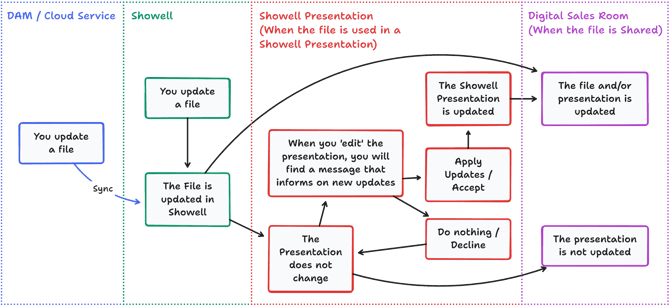
What happens to all my Showell Presentations and Shares when I update a file?
🔔 Troubleshooting
I cannot limit my users' read privileges in Azure/SharePoint
If it's not possible to limit the user's read privileges in Azure/SharePoint, Showell can make these limitations on our end. Please contact Showell Support with your request and we will help you further
I am unable to sync content, or syncing fails
It might be so that the authorization is revoked from the SharePoint/OneDrive side. Therefore you will have to re-authorize. See Point 2A - Step 3.
Synchronization fails after MFA, sign-in frequency, or Conditional Access changes
If your Microsoft 365 tenant uses strict Conditional Access policies, Showell may no longer be able to refresh the authorization token in the background.
This can happen when Microsoft requires a new interactive sign-in, MFA prompt, compliant device check, or another Conditional Access requirement that cannot be completed by a background synchronization process.
First, try re-authorizing the Microsoft 365 integration. If the issue returns, ask your IT team to review the Conditional Access policies that apply to the Showell Enterprise Application and the dedicated integration user.
If your organization cannot adjust these policies for user-based authentication, a service account / app-only authentication setup may be a better fit.
Please contact your dedicated Showell CSM or Showell Support for guidance.